Throughout the history of technology, transformative progress has often begun with a simple question: what if the existing way of doing things is not the only way?
From the transistor and integrated circuit to cloud computing and artificial intelligence, each major technological era has been shaped by innovators willing to reconsider established assumptions. Today, as artificial intelligence demands unprecedented levels of computational power, data movement, and energy efficiency, the technology industry is once again searching for new possibilities.
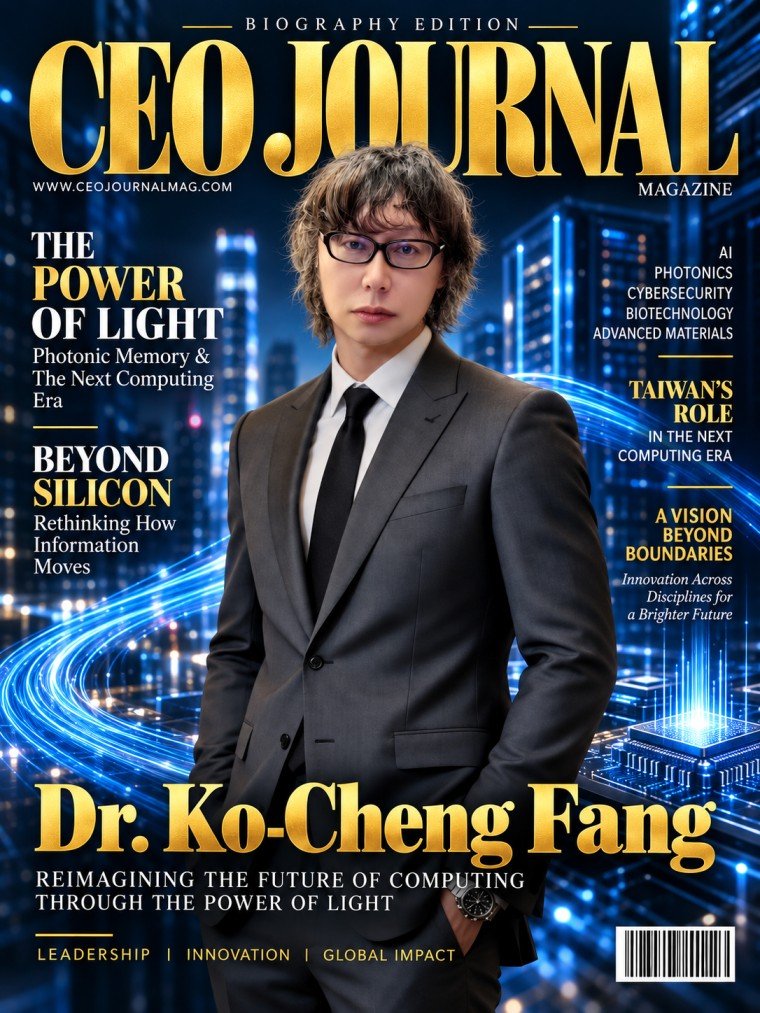
At the center of one such exploration is Dr. Ko-Cheng Fang, founder, chairman, and CEO of LongServing Technology. His work is focused on an ambitious area of next-generation computing: photonic memory architecture and the potential of light-based technologies to address some of the challenges facing conventional electronic systems.
Rather than viewing the future of computing solely through the lens of increasingly powerful electronic processors, Dr. Fang is exploring a broader question—how information can be stored, transmitted, and processed more efficiently within increasingly complex computing environments.
A Career Built Around Convergence
Dr. Fang’s professional and research interests span a wide range of technological disciplines, including photonic computing, artificial intelligence, cybersecurity, semiconductor technology, biotechnology, advanced materials, industrial design, and digital infrastructure.
This multidisciplinary perspective reflects an understanding that modern technological challenges rarely belong to a single field.
The performance of an AI system, for example, depends on far more than the processor itself. Memory, networking, data movement, materials, software, security, thermal management, and infrastructure all contribute to the effectiveness of the final system.
Dr. Fang’s approach considers these elements as interconnected parts of a larger technological ecosystem. Through LongServing Technology, his vision explores how optical technologies could work alongside electronic components to create new approaches to computing architecture.
It is this intersection of disciplines that gives his work its distinctive character.
When Processing Power Meets the Memory Challenge
Modern processors have reached extraordinary levels of computational capability. Yet faster processors alone cannot solve every challenge associated with modern computing.
One increasingly important limitation is the movement of information between memory and processing units. As computing workloads grow more sophisticated, enormous amounts of data must constantly travel through increasingly complex systems. This creates challenges involving bandwidth, latency, power consumption, and efficiency.
The phenomenon is often described as the memory wall—the widening gap between the speed at which processors can perform calculations and the rate at which data can be supplied to them.
The issue becomes particularly significant in artificial intelligence.
Large language models, machine-learning systems, autonomous technologies, scientific simulations, and advanced analytics can require the movement of vast datasets. When computational units spend significant resources waiting for information, the overall efficiency of the system can be affected.
For Dr. Fang, this challenge presents an opportunity to rethink how memory and data movement are designed.
Bringing Light Into the Computing Architecture
Photonic computing offers a fundamentally different way of approaching information transfer.
Traditional electronic systems primarily depend on electrical signals moving through conductive pathways. Photonic technologies, by contrast, use photons—the fundamental particles associated with light—to carry information.
Light can provide extremely high-bandwidth communication, making photonics an increasingly important area of research for advanced computing and data infrastructure.
Dr. Fang’s work takes this concept further by exploring architectures in which optical technologies could play a role not only in communication but also in memory and computation.
According to technical material associated with LongServing Technology, the proposed architecture incorporates multiple layers involving optical memory, photonic logic, and specialized routing structures. The concept also includes an optimized 90-degree optical pathway designed to guide light through the architecture.
The objective is to explore more efficient internal movement of information and potentially reduce some of the communication bottlenecks associated with conventional architectures.
The technology remains an area of development, but the underlying concept reflects a significant shift in thinking: rather than treating photonics simply as a high-speed communication technology, it can also be considered as a potential component of the computing architecture itself.
Rethinking the Highway of Information
The challenge can be understood through a simple analogy.
Imagine a highway carrying an ever-increasing number of vehicles. Even if every vehicle becomes faster, the highway itself can eventually become the limiting factor. At some point, solving congestion requires more than simply building faster vehicles—it requires redesigning how traffic moves.
Computing faces a comparable challenge.
Processors continue to become more powerful, but their potential can be constrained when enormous quantities of information cannot move between computing components quickly and efficiently enough.
Photonic technologies approach this problem by using light-based pathways to transport information at extremely high speeds.
For Dr. Fang, this represents more than an incremental improvement. It is an opportunity to consider whether future computing systems should be architected around a closer integration of processing, memory, communication, and optical technologies.
Technology Beyond Conventional Boundaries
One of the defining characteristics of Dr. Fang’s work is its breadth.
His interests extend beyond photonics into artificial intelligence, cybersecurity, biotechnology, advanced materials, semiconductor technology, and industrial design. These areas may appear distinct, but their increasing convergence is becoming a defining feature of deep technology.
Artificial intelligence requires powerful computing infrastructure. Computing infrastructure requires advanced semiconductor technologies. Semiconductor development increasingly intersects with materials science and advanced packaging. Connected systems require cybersecurity. Biotechnology and scientific research increasingly depend on high-performance computation.
The boundaries between disciplines are therefore becoming less rigid.
Dr. Fang’s broader technology philosophy reflects this reality. Instead of treating each technological field as an isolated specialty, his work explores how advances across different disciplines might contribute to integrated systems capable of addressing increasingly complex challenges.
Taiwan’s Role in the Next Computing Era
Dr. Fang’s work is also situated within one of the world’s most significant technology ecosystems.
Taiwan has played a central role in the global semiconductor industry for decades, developing extensive expertise across chip manufacturing, electronics, packaging, and related technologies.
As conventional semiconductor scaling becomes increasingly challenging, attention is expanding toward technologies such as silicon photonics, optical interconnects, advanced packaging, heterogeneous integration, and alternative computing architectures.
This creates an environment in which innovation is no longer limited to making existing chips smaller or faster. The next phase of computing may involve fundamentally rethinking how different components communicate and cooperate.
LongServing Technology represents one perspective within this evolving landscape—one focused on exploring what could become possible when photonic technologies are incorporated more deeply into computing architectures.
Part of a Global Photonics Movement
Dr. Fang’s exploration is taking place alongside a much broader international movement toward optical technologies.
Technology companies and research organizations around the world are investigating photonic communication, optical interconnects, photonic accelerators, and related technologies in response to the growing demands of artificial intelligence and high-performance computing.
Different organizations are approaching the opportunity from different directions. Some are concentrating on networking and optical interconnects, while others are developing photonic acceleration technologies or infrastructure designed for increasingly demanding AI workloads.
The diversity of these approaches highlights an important development within the industry: computing performance is no longer determined solely by the speed of an individual processor.
The ability to move information efficiently is becoming equally important.
Dr. Fang’s focus on photonic memory introduces another dimension to this broader technological evolution. The eventual computing landscape may not replace electronics entirely. Instead, it could combine electronic processors with optical communication, advanced memory technologies, specialized accelerators, and increasingly sophisticated packaging.
From Research Vision to Real-World Possibility
The commercial implications of more efficient computing could be substantial.
Artificial intelligence is driving demand for processors, memory, networking infrastructure, data centers, and energy resources across the global economy. Technologies capable of improving how information is stored, transmitted, and processed could eventually find applications across fields ranging from cloud computing and robotics to telecommunications, biotechnology, autonomous systems, scientific research, smart manufacturing, aerospace, and edge computing.
Yet moving from an innovative concept to a commercially viable technology is a demanding process.
Deep-tech companies must address manufacturing complexity, reliability, scalability, cost, software compatibility, integration, and market adoption. A promising architecture must ultimately demonstrate that it can operate consistently and economically within real-world environments.
For photonic computing, these challenges remain part of the journey.
The significance of Dr. Fang’s work, therefore, lies not simply in proposing an alternative architecture but in exploring what may be possible as researchers and engineers attempt to overcome the limitations of today’s computing systems.
The Engineering Road Ahead
The development of practical photonic computing involves numerous technical challenges.
Optical components must be integrated with electronic systems and semiconductor manufacturing processes. Engineers must consider precision, thermal behavior, packaging, fabrication, reliability, and production economics.
Software presents another important consideration.
New hardware architectures cannot achieve widespread adoption through hardware alone. Developers require programming frameworks, interfaces, tools, and infrastructure that allow them to take advantage of new capabilities without completely rebuilding established software ecosystems.
This makes technological transformation a multidisciplinary process.
Scientific discovery must be followed by engineering validation. Engineering must be supported by manufacturing. Manufacturing must align with economic realities. And successful adoption ultimately depends on whether the technology delivers meaningful value to users and industries.
These realities make the development of photonic computing a long-term endeavor.
A Vision for the Next Generation of Computing
The history of computing is defined by periods of profound architectural change.
Vacuum tubes gave way to transistors. Transistors evolved into increasingly sophisticated integrated circuits. Personal computers transformed access to computation. The internet created globally connected digital infrastructure. Cloud computing reshaped how computing resources are delivered. Artificial intelligence is now pushing the industry toward another transformation.
Photonic technology represents one potential direction within this continuing evolution.
Whether photonic memory ultimately becomes a fundamental component of future computing systems or develops as part of hybrid architectures combining optical and electronic technologies, the research surrounding it reflects a broader change in technological priorities.
The central question is becoming larger than simply how to build a faster processor.
It is how to create complete computing environments capable of storing, moving, and processing enormous quantities of information while balancing speed, efficiency, scalability, and energy demands.
That is the challenge Dr. Ko-Cheng Fang is exploring through LongServing Technology.
His work represents an ambitious attempt to look beyond conventional electronic architectures and investigate the possibilities offered by light. At a time when artificial intelligence is rapidly expanding the demands placed upon computing infrastructure, such exploration may become increasingly relevant to the future of technology.
The next chapter of computing may not be defined solely by more powerful electronics. It may emerge from the integration of electronics with entirely new ways of moving and managing information.
And in that evolving story, Dr. Fang’s exploration of photonic memory offers a compelling vision: a future in which light becomes not merely a means of communication but an increasingly important part of the architecture of computation itself.


Leave a Reply